Needle Depth Guide
To get the best results from your microneedling treatment, we recommend tailoring the cartridges that you use to the area of your face that you're treating.
As different areas of the face vary in texture (for example, fattier areas such as the cheeks can handle a more robust needle depth than the delicate skin below the eyes).
Here are our recommended guides for choosing the appropriate needle depth on your face dependant on your skin type. All measurements are in millimeters (mm).
Understanding Microneedling Depth
Microneedling depth is measured in millimeters (mm) and typically ranges from 0.25mm to 3.0mm. The depth you choose depends on the skin concern being treated, the area of the skin, and your skin type. The general rule is: the deeper the needle, the more intensive the treatment and the better it is for targeting deeper skin concerns like scars or stretch marks.
Needle Depth Guide:
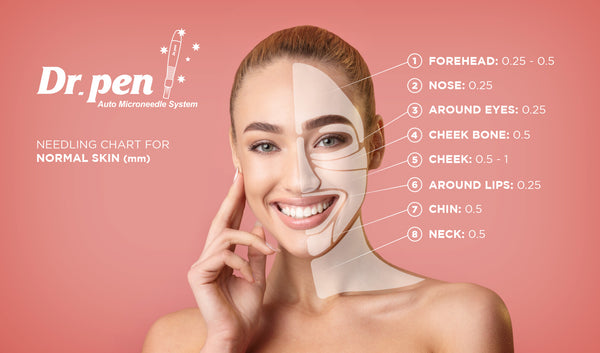
It's also important to consider the type of skin that you're treating, as thicker skin (such as mature skin or skin with stretch marks and scar tissue) may require a slightly deeper treatment to get the optimum results.
1. Forehead and Glabella (Between the Eyebrows)
- Recommended Depth: 0.5mm to 1.0mm
The forehead and glabella (the area between your eyebrows) are common areas for fine lines and wrinkles. Using a depth of 0.5mm to 1.0mm is ideal for stimulating collagen production to smooth out these fine lines. Since this area has thinner skin compared to other parts of the face, a shallower depth is often enough to see noticeable improvements without causing irritation.
For frown lines or expression lines between the eyebrows, a slightly deeper treatment of 1.0mm can help stimulate collagen and elastin to promote smoother, firmer skin.
2. Cheeks and Jawline
- Recommended Depth: 0.5mm to 1.5mm
The cheeks and jawline are areas where people often seek improvement in skin texture, tone, and the reduction of large pores. A depth of 0.5mm to 1.5mm is typically enough to treat these concerns.
For sagging skin or deep wrinkles on the jawline or around the cheeks, a 1.5mm depth can help with lifting and tightening the skin. The cheek area can handle slightly deeper microneedling without causing significant discomfort.
3. Under-Eye Area
- Recommended Depth: 0.25mm to 0.5mm
The skin under the eyes is very delicate, so it’s important to use a shallow depth for this area to avoid irritation or damage. The optimal depth for treating under-eye concerns such as dark circles, fine lines, or wrinkles is 0.25mm to 0.5mm.
At this depth, microneedling helps improve the appearance of fine lines and can stimulate collagen production to thicken the skin under the eyes, making it less translucent and more youthful.
4. Nasolabial Folds (Smile Lines)
- Recommended Depth: 1.0mm to 1.5mm
Nasolabial folds, also known as smile lines or laugh lines, are areas where the skin tends to lose elasticity over time, creating deeper wrinkles. For these deeper lines, a 1.0mm to 1.5mm depth works best.
This depth can help reduce the appearance of these folds by stimulating collagen production in the deeper layers of the skin, which helps plump and firm the area.
5. Lips and Perioral Area (Around the Mouth)
- Recommended Depth: 0.5mm to 1.0mm
The lips and perioral area (around the mouth) are sensitive, and the skin here is thinner, so a shallower depth is recommended to avoid irritation or damage. 0.5mm to 1.0mm is perfect for treating fine lines around the mouth, improving skin texture, and even giving a slight plumping effect to the lips.
If you're targeting deeper lip lines (also known as smoker’s lines), a slightly deeper depth like 1.0mm is beneficial.
6. Nose
- Recommended Depth: 0.25mm to 0.5mm
Microneedling on the nose is commonly done to treat congestion, pores, or blackheads. The skin on the nose is usually thin and sensitive, so a very shallow depth is recommended for safety and comfort. 0.25mm to 0.5mm works best for improving skin texture and minimizing the appearance of large pores.
A deeper treatment should be avoided on the nose as it could cause irritation or even damage to the skin due to its sensitivity.
7. Neck and Décolletage
- Recommended Depth: 1.0mm to 1.5mm
The neck and décolletage are often neglected in skincare routines, but these areas can show signs of aging, including wrinkles, sagging, and sun damage. For the neck and chest, a 1.0mm to 1.5mm depth is ideal for stimulating collagen production and tightening the skin.
The deeper treatment helps address sagging or crepey skin, making it look firmer and more youthful over time.
8. Body (Stretch Marks, Scars, and Cellulite)
- Recommended Depth: 1.5mm to 2.5mm
For body treatments, such as stretch marks, scarring, or cellulite, deeper microneedling depths are needed. For stretch marks, a depth of 1.5mm to 2.0mm is typically used, and for more stubborn or deeper scars, 2.0mm to 2.5mm can be applied.
These deeper depths reach into the dermis, encouraging the healing of scars and stimulating collagen production in areas that have been damaged, resulting in smoother skin over time.
9. Scalp (Hair Regrowth)
- Recommended Depth: 1.0mm to 1.5mm
Microneedling is also becoming a popular treatment for promoting hair regrowth on the scalp. The ideal depth for microneedling on the scalp is 1.0mm to 1.5mm, as this allows the needles to penetrate the scalp's surface without causing too much discomfort.
Microneedling on the scalp stimulates hair follicles, increases blood circulation, and helps promote hair growth by encouraging the absorption of hair growth serums or treatments.
Conclusion: How to Choose the Right Depth
Choosing the right microneedling depth depends on the area being treated and your specific skin concerns. Shallow depths (0.25mm to 0.5mm) are great for sensitive areas like under the eyes, while deeper depths (1.0mm to 2.5mm) are necessary for treating more serious skin issues like scars, stretch marks, and signs of aging.
If you're new to microneedling or unsure about which depth to use, it’s always a good idea to start with a professional treatment. A licensed practitioner will be able to adjust the depth of the microneedling device based on your skin type and needs, ensuring the best and safest results.
Remember, consistency is key! To see long-term benefits from microneedling, follow a regular treatment schedule and practice proper aftercare, including sun protection and hydration.
Happy microneedling! ✨
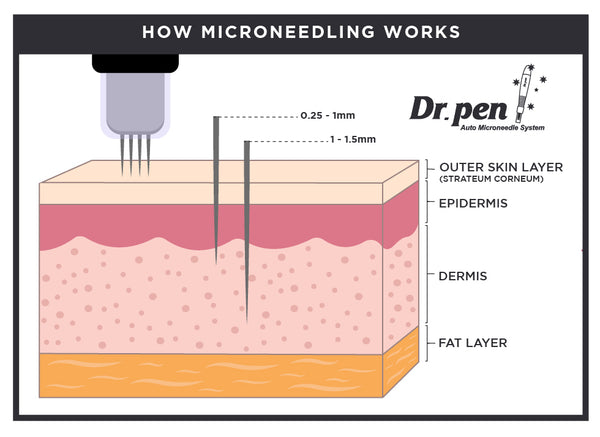
How Microneedling Works
Our chart below highlights how microneedling works. The needles can penetrate the dermis at a relatively low setting and achieve the wound healing response that is needed to create collagen.